What lies beneath the surface
The first thing you see on a tatami mat is the surface: Igusa, Washi or Migusa. What really matters, though, is the core (tatami toko) underneath. It carries the surface, decides how the mat feels under your feet, and how long it lasts.
Thickness matters most. Many "convenience" mats on the market today are only 10 or 15mm thick. They lack substance: when you walk on them, you feel the hard floor right away. The foot is very sensitive, and a mat that thin cannot make you forget what is underneath.
Thin mats have spread because of cost as much as demand. They are made by machine with almost no precision handwork, and because they are light and compact, they are cheap to pack and ship. A real, thick tatami mat needs a great deal of skilled handwork that machines cannot fully replace, and its weight calls for sturdy packing and higher freight costs.
Then there is lifespan. Thin mats wear quickly and need replacing often. A dense core of 50mm or more is built to last for decades. That is the choice we have made: tatami that becomes a lasting part of your home, not a consumable.
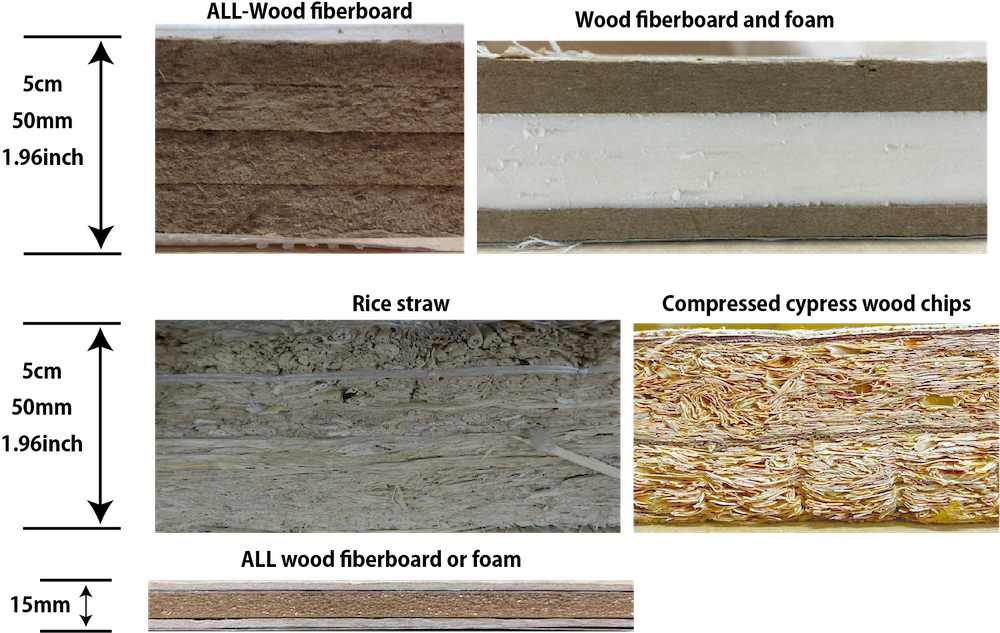
The traditional core, and the heart of our craft. We stack bundles of natural rice straw about 40cm high, then compress them and stitch them with strong thread into a very dense core 5cm thick. It feels heavy and firm, and it absorbs impact well: a fall on it is much softer than on wood flooring or concrete. Benefits: breathable, evens out humidity naturally, has the scent of straw, and ages well.
The modern core for today's homes. Made from high-density wood fiberboard, it stays flat and stable even with heating and changing humidity. It meets F☆☆☆☆, the best Japanese rating for formaldehyde emissions. Benefits: very stable in shape, long-lasting, and an even surface that suits any room.
Bringing a thick, heavy tatami mat of 50mm or more from Tokyo to your door takes careful logistics. Shipping and logistics costs are paid by the customer.
We do not hide these costs in the mat price, because that would mean saving on materials or work. With shipping charged separately, the whole mat price goes into quality, and you can see exactly what transport costs.
Planning a tatami room? We are happy to help with the layout and shipping.
Ask Our Workshop